WooCommerce, Shopify, PrestaShop or Magento: the 2026 comparison, in tables

Four platforms, one choice. WooCommerce, Shopify, PrestaShop and Magento all do the same thing on paper: sell online. What changes is who pays for what, who owns the data, how much technical work it takes and what happens when the catalogue grows. We put them side by side on more than eighty criteria, grouped by topic, with indicative prices re-read on the official pages on 13 October 2026, and we also say where PrestaShop loses.
The four in brief
Two are software you install on your own server (WooCommerce, which is a WordPress extension, and PrestaShop), one is a subscription service (Shopify), and one comes in two editions (Magento Open Source, free, and Adobe Commerce, licensed).
How widespread are they? Store Leads counts live stores with the same method for all four: in Italy WooCommerce leads, in France Shopify does, and PrestaShop is far more present in France and Spain than in Germany.
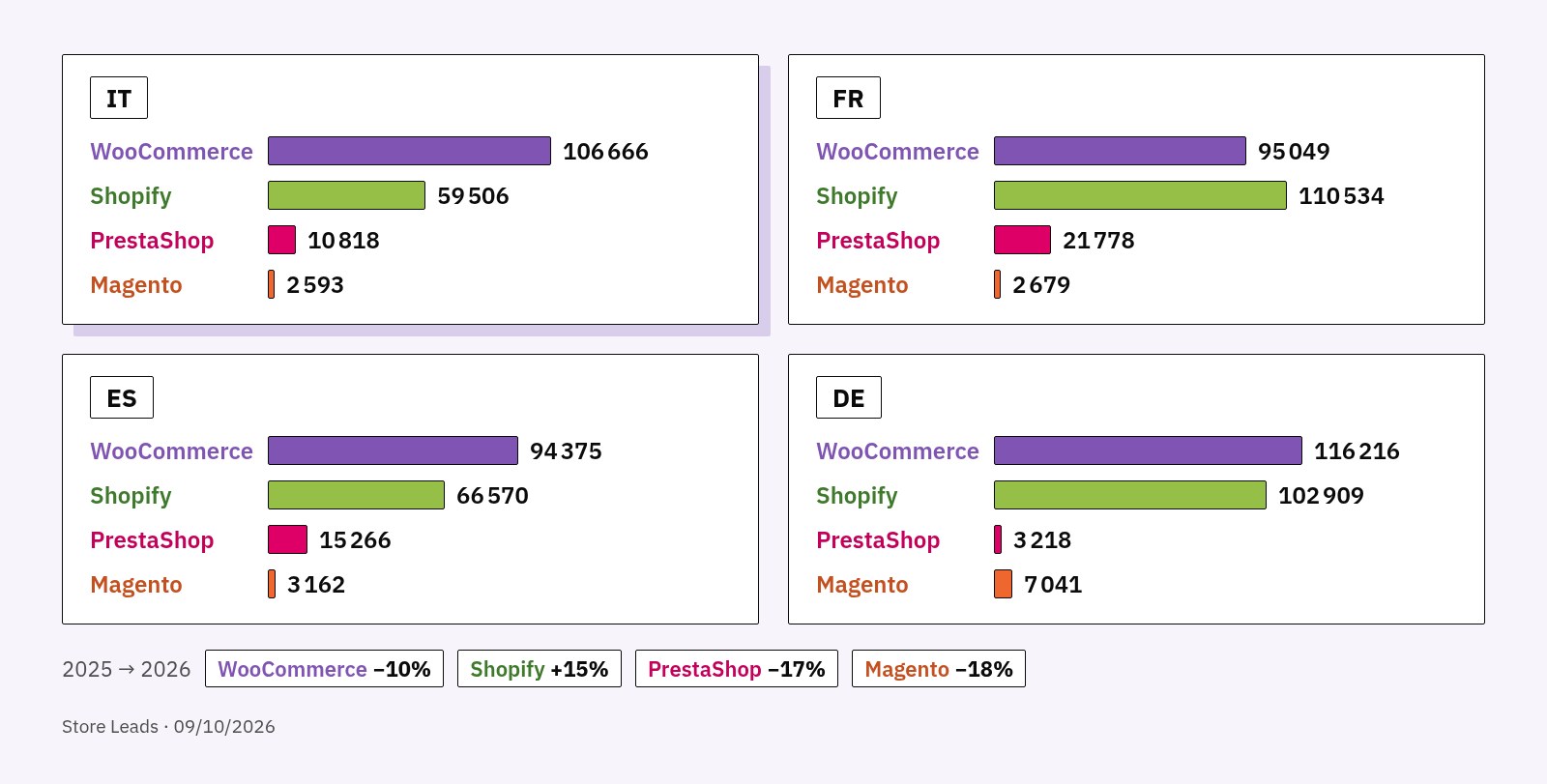
How to read the tables: "Built in" means included in the platform with nothing else to install; Plugin, App, Module and Extension are the names WooCommerce, Shopify, PrestaShop and Magento give to add-ons. "Plus only" and "Adobe Commerce only" point to the paid editions. The last column says where a figure comes from when it is not obvious, and when it is our own assessment. On a phone the tables scroll sideways.
Licence and ownership
| Criterion | WooCommerce | Shopify | PrestaShop | Magento | Note and source |
|---|---|---|---|---|---|
| Model | WordPress plugin you install | Subscription service | Software you install | Software you install (Open Source) or Adobe Commerce | |
| Software licence | GPL v2 or later | Proprietary | OSL 3.0 core, AFL 3.0 modules | OSL 3.0 (Open Source); commercial (Adobe Commerce) | Licence files on GitHub, 13/10/2026 |
| Core code can be modified | Yes | No: you work on theme and apps | Yes | Yes | |
| Who sets prices and service rules | You and your host | Shopify | You and your host | You; Adobe for the Commerce licence | |
| Company behind it | Automattic | Shopify Inc. | PrestaShop SA, part of cyber_Folks since 18/2/2026 | Adobe | PrestaShop: official cyber_Folks press release of 18/2/2026 (investors.cyberfolks.pl) |
| Offer for large stores | No dedicated edition | Plus, from about €2,100/month depending on contract length | Enterprise, on request | Adobe Commerce, on quote | shopify.com/it/plus/pricing, prestashop.it/offerte-prestashop, business.adobe.com, 13/10/2026 |
Prices and fees read on 13 October 2026 on the official websites: they change over time, with offers, with monthly or yearly billing and with the country. Before deciding, always check the official pages.
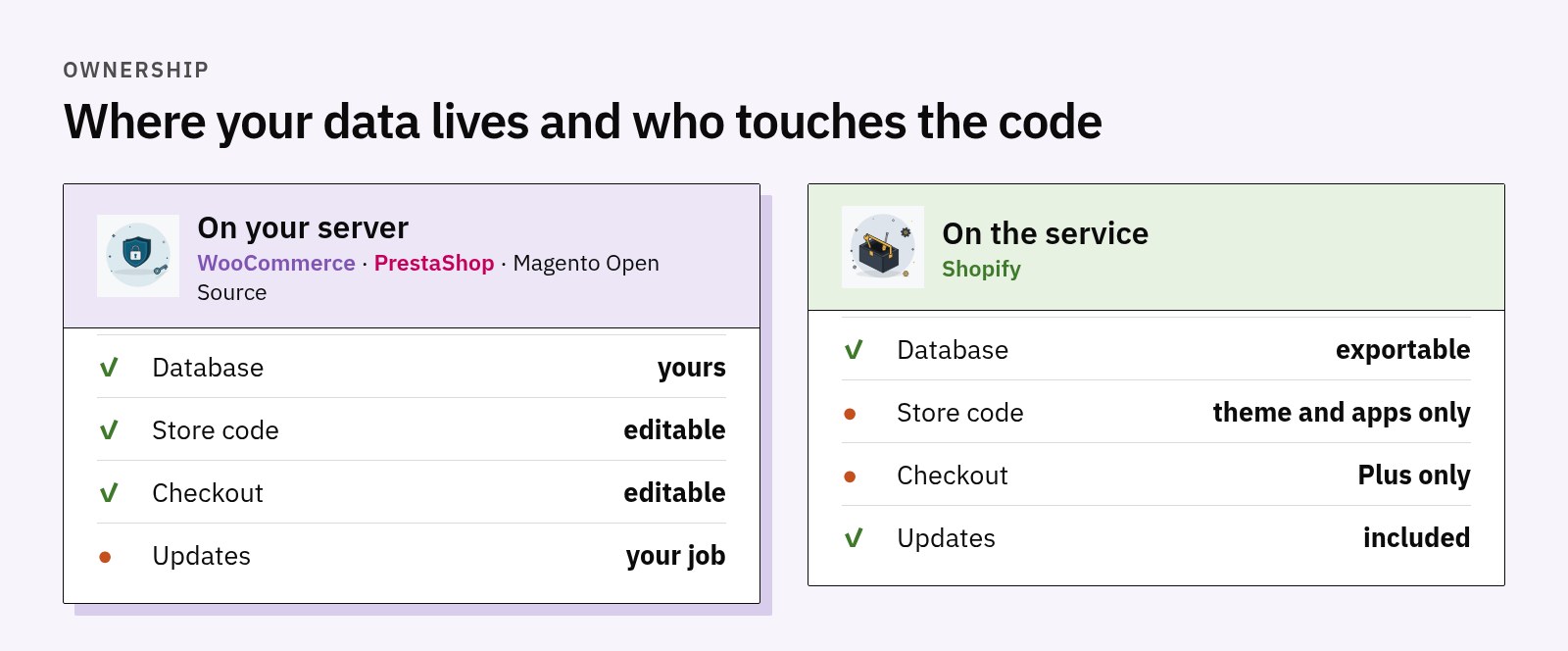
There is no single right answer. With Shopify you hand over security, updates and infrastructure, and you accept the service's rules. With installed platforms you have full control, and with control comes the responsibility for updates.
Costs: licence, hosting, extensions, payments
Indicative prices. Prices and fees read on 13 October 2026 on the official websites: they change over time, with offers, with monthly or yearly billing and with the country. Before deciding, always check the official pages.
The market moved in 2026. Shopify renamed its middle plan Grow (between 56 and 74 euros a month, depending on billing) and added an Agentic plan with no plan fee to sell on artificial intelligence channels, paying only fees. PrestaShop sells a hosted offer, Hosted, at 24 to 29 euros a month. Adobe Commerce remains on quote: estimates published by agencies start at a few tens of thousands of dollars a year.
| Criterion | WooCommerce | Shopify | PrestaShop | Magento | Note and source |
|---|---|---|---|---|---|
| Licence or plan fee | Free | Between €19 and €384/month depending on plan and billing; Plus from about €2,100/month | Free | Open Source free; Adobe Commerce on quote | Fees excl. VAT, read 13/10/2026. Adobe only publishes "customised pricing"; estimates published by agencies start at a few tens of thousands of dollars a year |
| Official hosted version | WordPress.com Commerce, between €45 and €70/month depending on billing | It is the product itself | Hosted offer on PrestaShop 8, between €24 and €29/month depending on billing | Adobe Commerce Cloud, on quote | wordpress.com/pricing, prestashop.it/offerte-prestashop/hosted, 13/10/2026 |
| Typical hosting | Shared, managed or cloud: roughly €10 to €250/month | Included in the plan | Shared, managed or cloud: roughly €10 to €250/month | Server or cloud with OpenSearch: roughly €80 to €250/month and up | Indicative ranges from the public price lists of several providers, excl. VAT, 13/10/2026; very large catalogues cost more |
| Typical extension price | Many free; pro versions on yearly subscription | Monthly apps, many with a free plan | One-off, usually from a few tens of euros to about €120 | Roughly $100 to $600, with yearly renewal | PrestaShop: 2,114 paid modules on Addons, Presta365 survey of 13/10/2026. Magento: vendor pages (indicative) |
| Extension updates | While the subscription is active | Included in the app fee | Business Care: about 40% of the module price | Yearly renewal, set by the vendor | Addons, read 13/10/2026 |
| Own payment service (cards) | WooPayments: roughly between 1.5% and 3.5% plus a fixed fee, depending on country and card type; more with currency conversion | Shopify Payments: roughly between 1.4% and 3.6% plus a fixed fee, depending on plan, country and card type | PrestaShop Checkout: roughly between 1.2% and 3.5% plus a fixed fee, depending on country, method and card | None of its own; PayPal and Braintree built in | Official rates read on 13/10/2026: check the rate for your country on the official website |
| Extra fee with an external payment gateway | No | Between 0.2% and 2% depending on the plan, lower on the dearer plans | No | No | shopify.com/it/prezzi, 13/10/2026 |
Prices and fees read on 13 October 2026 on the official websites: they change over time, with offers, with monthly or yearly billing and with the country. Before deciding, always check the official pages.
Shopify plans in euros
| Plan | Monthly fee, excl. VAT | Notes |
|---|---|---|
| Basic | Between €19 and €27, depending on yearly or monthly billing | Entry plan; highest extra fee with an external payment gateway |
| Grow (formerly Shopify) | Between €56 and €74, depending on yearly or monthly billing | 5 admin users |
| Advanced | Between €289 and €384, depending on yearly or monthly billing | 15 admin users |
| Plus | From about €2,100, depending on contract length | 1- or 3-year contract; unlimited users; expansion stores included |
Prices and fees read on 13 October 2026 on the official websites: they change over time, with offers, with monthly or yearly billing and with the country. Before deciding, always check the official pages.
These are the fees read on 13 October 2026 on Shopify's Italian page, excluding VAT: the lower figure applies with yearly billing, the higher one with monthly billing; on Plus the starting price depends on the contract length. With Shopify Payments, cards cost roughly between 1.4% and 3.6% plus a fixed fee, depending on plan, country and card type: check the rate for your country on the official website. With an external payment gateway Shopify adds a fee between 0.2% and 2%, lower on the dearer plans.
The chart below shows only the cost of the platform itself, for three typical stores. Card fees are not included because you pay them on any platform; the extra fee Shopify charges when you do not use Shopify Payments is included.
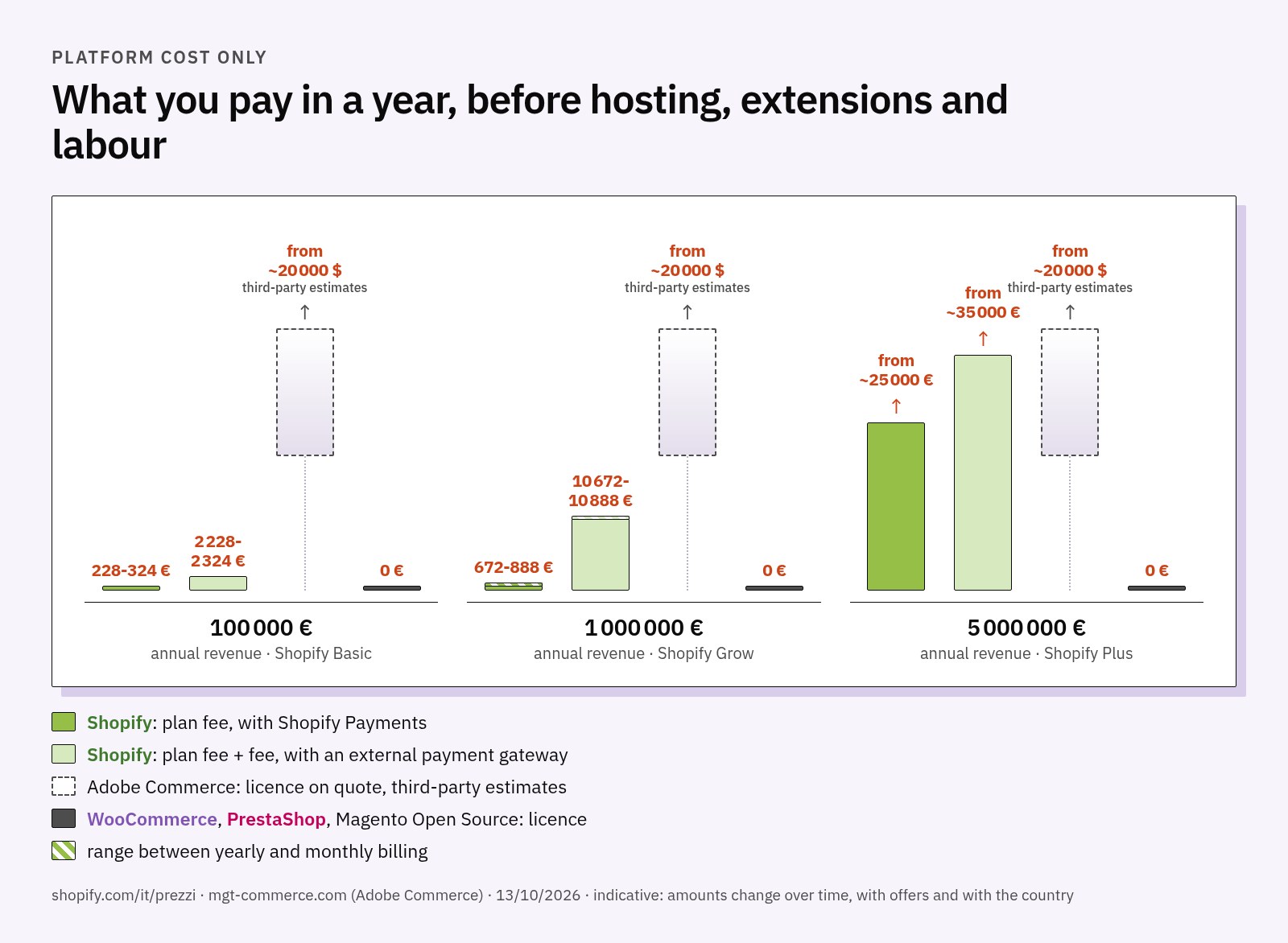
How to read it: for a store turning over 100,000 euros a year, Shopify Basic costs between 228 and 324 euros in plan fees, depending on billing, which become 2,228-2,324 with an external payment gateway. A 1 million store on Grow pays between 672 and 888 euros, which become 10,672-10,888. A 5 million store on Plus starts at about 25,000 euros a year. Adobe does not publish Adobe Commerce prices: estimates published by agencies start at a few tens of thousands of dollars a year, and the chart shows them as an open range, with no precise figure. On installed platforms the licence costs nothing, but you pay for hosting, updates and technical support: the full bill is further down, for three profiles, again as ranges.
Hosting and data
| Criterion | WooCommerce | Shopify | PrestaShop | Magento | Note and source |
|---|---|---|---|---|---|
| Who runs the server | You or a managed host | Shopify | You, a host or the Hosted offer | You or Adobe’s cloud | |
| Choice of the country where data lives | Yes | No | Yes | Yes | |
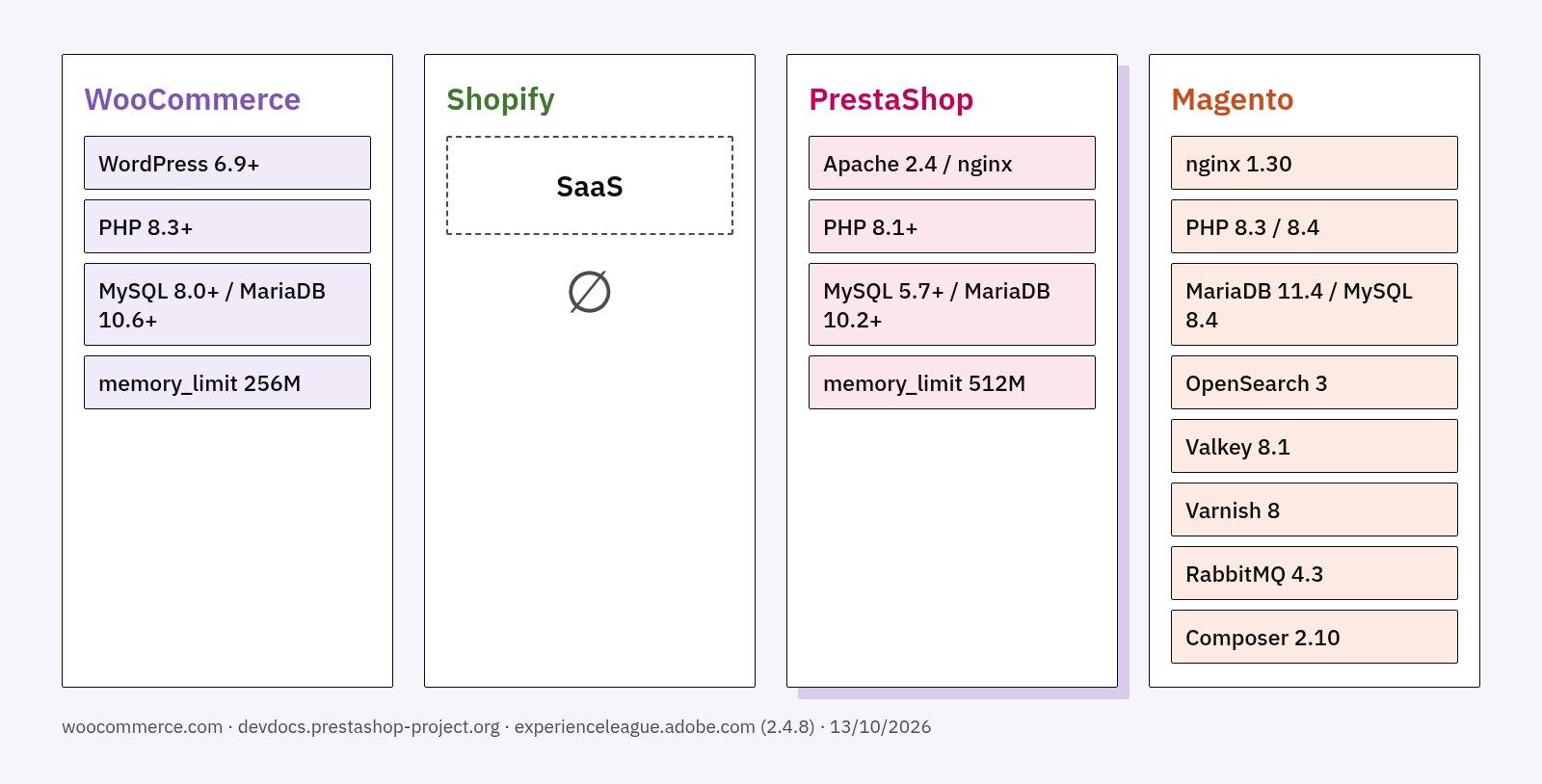
| PHP | 8.3 or later recommended (works from 7.4) | Not needed | 8.1 or later (PrestaShop 9) | 8.3 or 8.4 (2.4.8) | Official requirement pages, 13/10/2026 |
| Database | MySQL 8.0 or MariaDB 10.6 recommended | Not needed | Minimum MySQL 5.7 or MariaDB 10.2 | MariaDB 11.4 or MySQL 8.4 | |
| Required services besides web server and database | WordPress | None | None | OpenSearch; Valkey, Varnish, RabbitMQ also listed | experienceleague.adobe.com, 2.4.8 requirements |
| Exporting all data | Full database | CSV and API, not the database | Full database | Full database | |
| Admin users | Unlimited, with roles | 5 on Grow, 15 on Advanced, unlimited on Plus | Unlimited, with profiles and permissions | Unlimited, with roles | shopify.com/it/prezzi, 13/10/2026 |
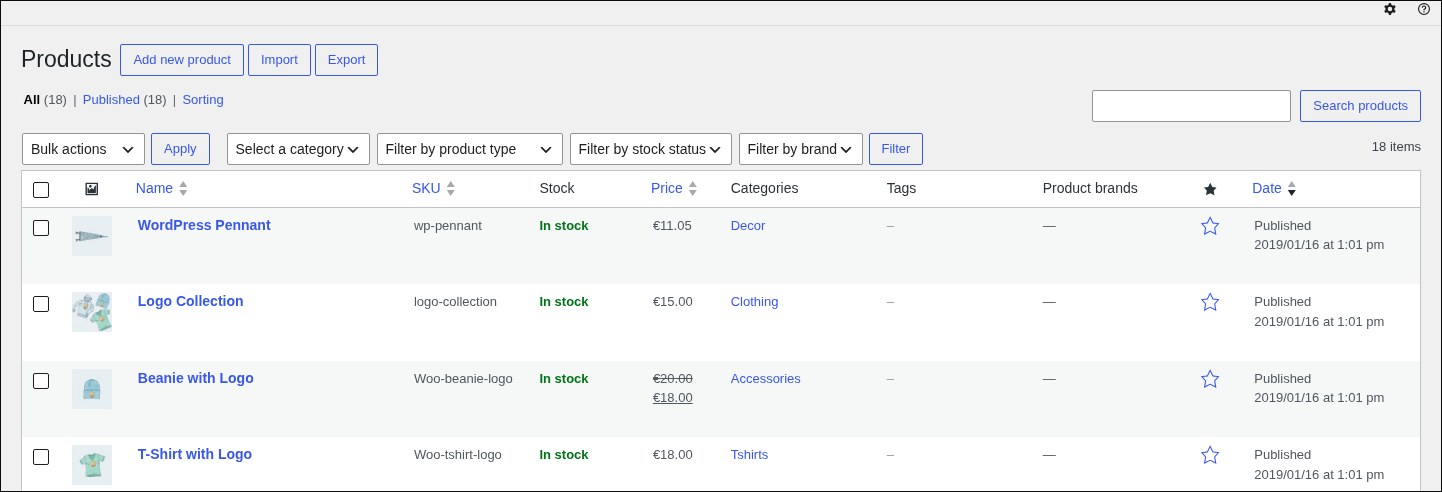
WooCommerce is managed from the WordPress dashboard, which many people already know: products, orders and settings sit next to pages and posts.
Updates and security
| Criterion | WooCommerce | Shopify | PrestaShop | Magento | Note and source |
|---|---|---|---|---|---|
| Who installs updates | You; automatic updates can be switched on | Shopify, always | You | You, with Composer | |
| Version on 13/10/2026 | 11.2.1 (9/10/2026) | Single, updated continuously | 9.2.0 (30/9/2026) | 2.4.9 (12/5/2026); 2.4.10 in alpha | GitHub releases |
| Release pace | Frequent releases, several a year | Nothing to install | Minor every 6-9 months, patches about every 6 weeks | One minor a year, scheduled security patches | prestashop-project.org (release cycle); experienceleague.adobe.com (versions) |
| End of support of versions | No published dates: stay on the latest | Not needed | Tied to releases: 1.7 closed with 9.0 (10/6/2025); 8.2 critical fixes only until 10.0 | Fixed dates: 2.4.7 until 31/5/2027, 2.4.8 until 31/5/2028 | build.prestashop-project.org; experienceleague.adobe.com, 13/10/2026 |
| Two-factor login for admins | Plugin | Built in | Module | Built in, on by default since 2.4 | PrestaShop 9.1.5: no two-factor code in the core (our check) |
| Captcha on store forms | Plugin | Built in (hCaptcha) | Module | Built in (reCAPTCHA) | |
| PCI DSS compliance | Yours and the payment provider’s | Shopify, level 1 | Yours and the payment provider’s | Yours; Adobe on its cloud | With payment pages hosted by the provider, the load on the store shrinks |
| Vendor security scanner | No | Not needed | No | Adobe Security Scan Tool, free |
Shopify updates itself. Magento publishes an end-of-support date for each version: 2.4.6 ended regular support on 11 August 2026. PrestaShop ties support to releases: 1.7 has had no fixes since 9.0 came out in June 2025, and 8.2 gets critical fixes only until 10.0. On PrestaShop, two-factor login and captcha come with a module.
Catalogue and performance
| Criterion | WooCommerce | Shopify | PrestaShop | Magento | Note and source |
|---|---|---|---|---|---|
| Variants per product | No fixed limit | Up to 2,048, with 3 options | No fixed limit | No fixed limit | help.shopify.com, 13/10/2026 |
| Product types | Simple, variable, grouped, external | Product with variants; bundles with the Bundles app | Simple, with combinations, pack, virtual | Simple, configurable, grouped, bundle, virtual, downloadable | |
| Downloadable products | Built in | Free Shopify app | Built in (virtual product with file) | Built in | |
| Warehouses and locations | Plugin | Built in: 10 locations, 200 on Plus | Module | Built in (Multi-Source Inventory) | shopify.com/it/prezzi, 13/10/2026 |
| Several stores from one admin | Plugin or separate installs | One store per subscription; 10 included on Plus, same brand | Built in (multistore) | Built in (websites, stores, views) | shopify.com/plus/pricing: main store plus 9 expansion stores; beyond that, at extra cost |
| Page cache | Plugin or host | Included, with CDN | Template cache built in; full page with a module | Full page built in; Varnish recommended | |
| Catalogues of tens of thousands of products | Needs cache and dedicated search | Managed infrastructure; filter limits | Needs dedicated search and cache | Built for it, costlier server | Presta365 assessment, October 2026 |
Shopify raised the limit to 2,048 variants per product, but still stops at three options (for example size, colour, material). PrestaShop and Magento run several stores from one admin out of the box; on Shopify each store is a subscription, except Plus expansion stores.
Search and navigation
Here the differences are sharp, and this is where PrestaShop out of the box loses to Magento.
| Criterion | WooCommerce | Shopify | PrestaShop | Magento | Note and source |
|---|---|---|---|---|---|
| Built-in search engine | Database (MySQL) | Shopify’s engine | Database, with its own index | OpenSearch or Elasticsearch, required | experienceleague.adobe.com: engine required since 2.4 |
| Faceted filters | Built-in filter blocks | Free Search & Discovery app | Bundled module (ps_facetedsearch) | Layered navigation built in | |
| Stated filter limits | None | At most 25 filters and 100 values; no filters on collections over 5,000 products | None; slow on large catalogues | None | help.shopify.com, 13/10/2026 (official) |
| Suggestions while typing | Plugin | Built in (predictive search) | Built in (ps_searchbar) | Built in | |
| Synonyms | Plugin | In Search & Discovery | Built-in aliases | Built in | |
| Dedicated engine to go further | Plugin (free ElasticPress, separate server) | Paid app, often tiered by product count | Module with Elasticsearch or OpenSearch | Already built in |
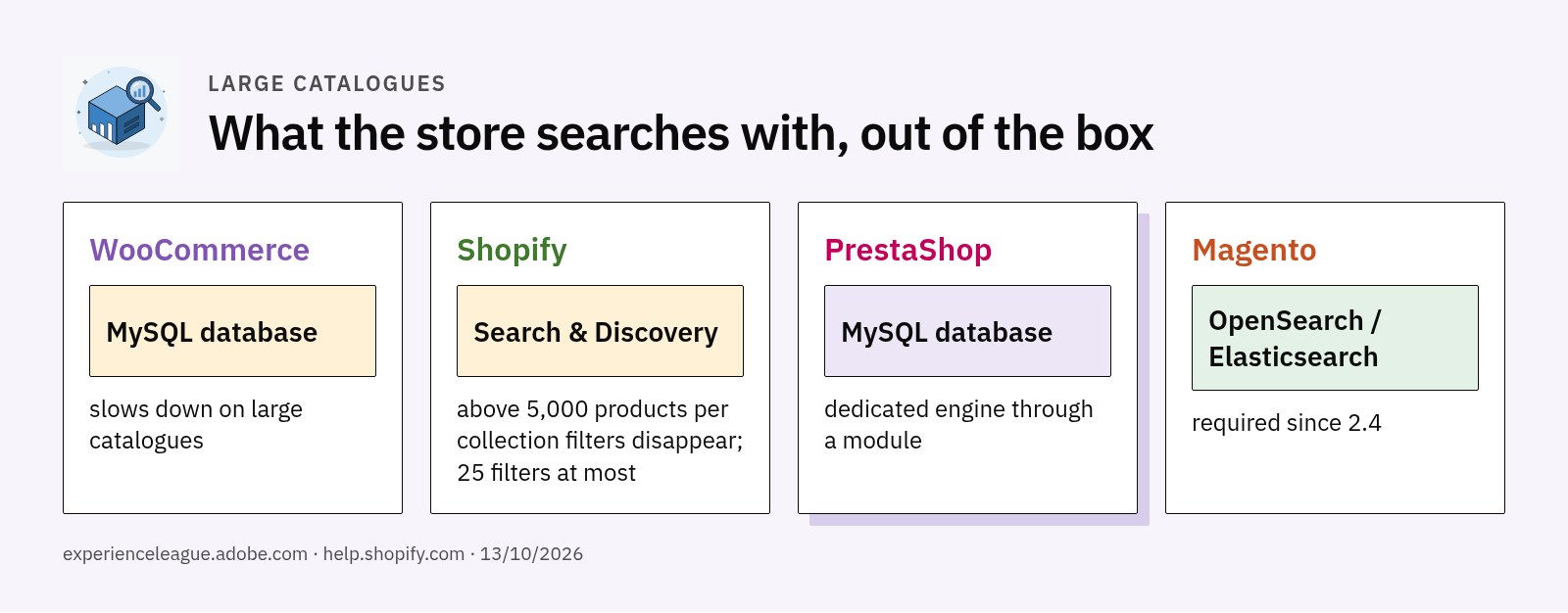
On PrestaShop the dedicated engine comes with a module. Ours, Elasticsearch Search and Faceted Navigation, moves search, filters and counts to Elasticsearch or OpenSearch: on our demo it indexes a 200,000-product catalogue.
Languages, currencies and EU tax
| Criterion | WooCommerce | Shopify | PrestaShop | Magento | Note and source |
|---|---|---|---|---|---|
| Several languages | Plugin, often paid (e.g. WPML) | Built in, with Markets | Built in | Built in (store views) | wpml.org/purchase, 13/10/2026 |
| Separate URLs per language | With the plugin | Built in | Built in (/it/, /en/) | Per store view | |
| hreflang tags between languages | With the plugin | Automatic | In the theme (Classic, Hummingbird) | Extension | Our check: PrestaShop 9 themes; in Magento’s code hreflang only appears as an HTML attribute |
| Several currencies | With WooPayments or a plugin | Built in; complete only with Shopify Payments | Built in | Built in | help.shopify.com, 13/10/2026 |
| VAT rates per EU country | Tables to fill in | Automatic calculation | Per-country rules built in | Tax rules built in | |
| Same VAT-inclusive price in every country | Plugin | Built in (dynamic tax-inclusive pricing) | Module or custom work | Built in (Cross Border Trade) | |
| VAT number check on VIES | Plugin | Built in with Shopify Tax, since 25/2/2026 | Module | Built in | changelog.shopify.com, read 10/10/2026 |
| PDF invoices and credit notes | Plugin | App | Built in | Built in | |
| Italian e-invoice (SDI) | Plugin | App | Module | Extension | All four need something extra |
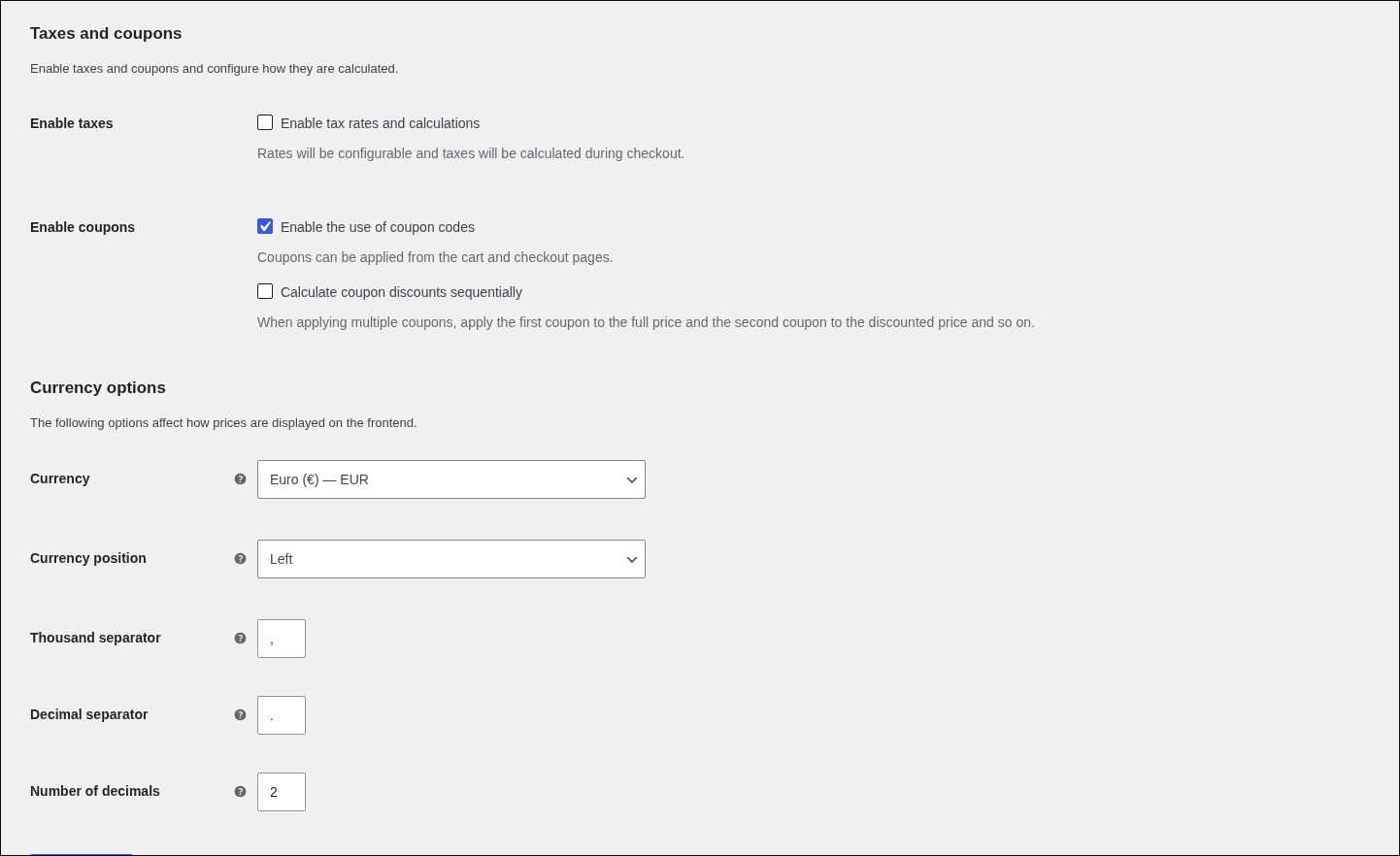
The Italian e-invoice through SDI, for those selling in Italy, always needs something extra on all four. PDF invoices with credit notes, on the other hand, come built in with PrestaShop and Magento, not with WooCommerce and Shopify. In WooCommerce, out of the box, the store has a single currency, as the general settings show.
B2B
| Criterion | WooCommerce | Shopify | PrestaShop | Magento | Note and source |
|---|---|---|---|---|---|
| Prices per customer group | Plugin | Built in on all plans since 2/4/2026 | Built in | Built in | changelog.shopify.com, read 10/10/2026 |
| B2B price lists or catalogues | Plugin | 3 catalogues; unlimited on Plus | One per group, no limit | Shared catalogues only in Adobe Commerce B2B | shopify.com/it/prezzi, 13/10/2026 |
| Quantity prices | Plugin | In B2B catalogues | Built in (specific prices) | Built in (tier prices) | |
| Prices hidden from guests | Plugin | App | Built in, per group | Extension; built in with Adobe Commerce B2B | |
| Company accounts with several buyers | Plugin | Built in (company profiles) | Module; new B2B mode in beta in 9.2 | Adobe Commerce B2B only | devdocs.prestashop-project.org: improved B2B, off by default |
| Quotes | Plugin | App | Module | Adobe Commerce B2B only | |
| Minimum order | Plugin | Quantity rules in B2B | Built in (minimum amount) | Built in (minimum amount) | |
| Payment at 30 or 60 days | Plugin | Built in with B2B (payment terms) | Module | Adobe Commerce B2B only | |
| Quick order by SKU | Plugin | App | Module | Adobe Commerce B2B only |
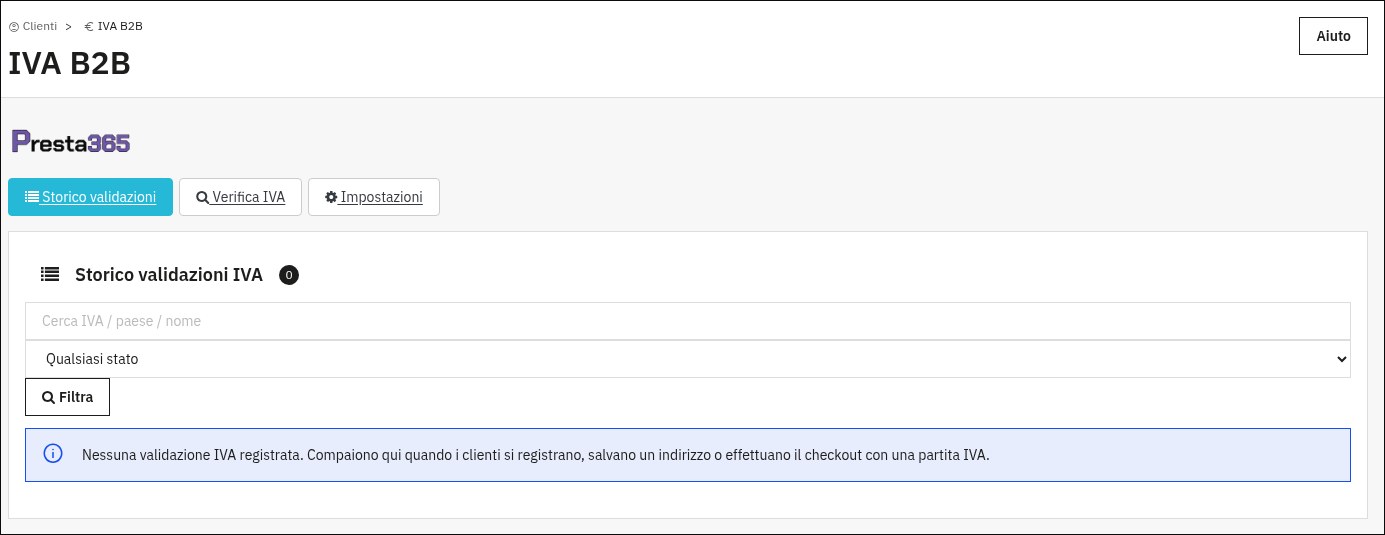
Shopify brought B2B to all plans in April 2026, with at most three catalogues outside Plus. PrestaShop 9.2 introduces a new B2B mode with company accounts, still in beta and off by default. On PrestaShop, checking the VAT number against the European Commission's VIES service and exempting intra-EU business customers comes with a module, for example our B2B VAT, which also keeps a history of the checks.
Checkout and payments
| Criterion | WooCommerce | Shopify | PrestaShop | Magento | Note and source |
|---|---|---|---|---|---|
| One-page checkout | Built in | Built in | Built in since 9.2 (30/9/2026), to switch on | Two steps built in | ps_onepagecheckout module bundled with PrestaShop 9.2.0 (GitHub) |
| Customising the checkout | Full (blocks and code) | With extensions; full only on Plus | Full (theme and modules) | Full | shopify.com/pricing: "fully customisable checkout" on Plus only |
| Abandoned cart emails | Plugin (e.g. MailPoet) | Built in | Cart list built in; emails with a module | Reminders only in Adobe Commerce | |
| Gift cards | Paid extension | Built in | Module | Adobe Commerce only | |
| Subscriptions and recurring payments | Paid extension | Free Shopify app | Module | Extension | |
| Local methods with the own payment service | WooPayments: Bancontact, iDEAL, Klarna, SEPA and more | Shopify Payments: Klarna, Bancontact, iDEAL, Bizum, MB WAY and more | PrestaShop Checkout: cards, PayPal, local methods | With provider extensions | Official fee pages, 13/10/2026 |
The news is PrestaShop 9.2, released on 30 September 2026: one-page checkout is now an official bundled module, to be switched on. Stores on PrestaShop 8 or on the Hosted offer keep the step-by-step checkout, or use a module.
SEO and content
| Criterion | WooCommerce | Shopify | PrestaShop | Magento | Note and source |
|---|---|---|---|---|---|
| Page URLs | Free-form | Fixed prefixes (/products/, /collections/) | Configurable patterns; the product keeps its id | Configurable | PrestaShop: id is a required keyword of the product route (Dispatcher, 9.1.5) |
| 301 redirects | Popular free plugins | Built in, with CSV import | For unavailable products; in bulk with a module | Built in (URL rewrites) | |
| XML sitemap | Built in (WordPress) | Automatic | Bundled module (gsitemap) | Built in | |
| Product structured data | Built in (JSON-LD) | In the themes | In the Classic and Hummingbird themes (JSON-LD) | Microdata in the Luma theme | |
| Blog | WordPress is a blog | Built in, basic | Module | Extension | |
| Visual page editor | Block editor built in | Section-based theme editor | Text editor; visual with a module | Page Builder built in | |
| Product reviews | Built in | App | Bundled module (productcomments) | Built in | Bundled modules: PrestaShop 9.2.0 composer.json |
For SEO, WooCommerce starts ahead on content and Shopify is the most rigid on URLs. PrestaShop and Magento sit in between: everything is possible, with modules or configuration. PrestaShop already writes hreflang tags between languages in the theme; Magento needs an extension.
Extensions, themes and marketplaces
| Criterion | WooCommerce | Shopify | PrestaShop | Magento | Note and source |
|---|---|---|---|---|---|
| Official marketplace | WordPress.org (free) and Woo Marketplace | Shopify App Store | PrestaShop Addons | Adobe Commerce Marketplace | |
| Marketplace modules and themes | Tens of thousands of free plugins | Thousands of apps | Over 3,200 themes and modules | Thousands of extensions | PrestaShop: prestashop.it, Hosted offer, 13/10/2026; the other exact counts are not published consistently |
| Official free themes | WordPress block themes | Yes, in the Theme Store | Classic and Hummingbird | Luma | Bundled themes: PrestaShop 9.2.0 composer.json |
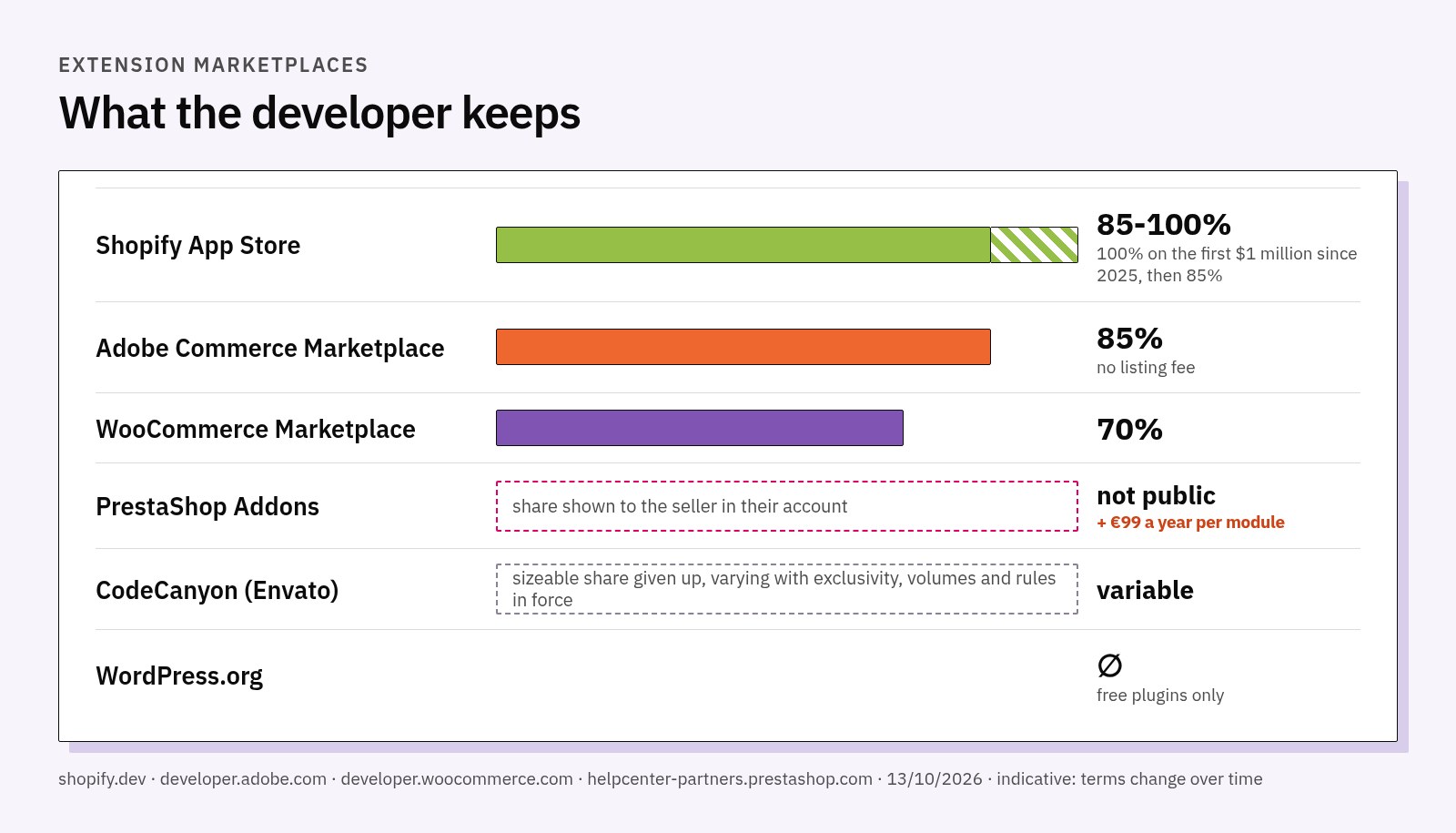
| Cost for extension sellers | Woo Marketplace: entry by selection | $19 once | €99 a year per module | No listing fee | Official marketplace pages, 13/10/2026 |
| Share kept by the developer | 70% | Between 85% and 100%: 100% on the first million dollars, then 85% | Addons keeps a share of sales, shown to the seller in their account | 85% | Official marketplace pages, 13/10/2026; for Addons the share is not on a public page |
Prices and fees read on 13 October 2026 on the official websites: they change over time, with offers, with monthly or yearly billing and with the country. Before deciding, always check the official pages.
Marketplace rules matter to buyers too: they decide what an extension costs, how often it renews and how closely it is checked.
| Marketplace | Cost for sellers | Developer share |
|---|---|---|
| PrestaShop Addons | €99 a year per module, since May 2024 | Addons keeps a share of sales, shown to the seller in their account |
| Shopify App Store | $19 once per account | Between 85% and 100%: 100% of the first million dollars earned since 2025, then 85%; net of processing fees |
| WooCommerce Marketplace | Entry by selection | 70% |
| WordPress.org | Free, free plugins only | No sales: pro versions are sold elsewhere |
| CodeCanyon (Envato) | None | The author gives up a sizeable share of the price, varying with exclusivity, volumes and the rules in force |
| Adobe Commerce Marketplace | No listing fee | 85% |
Prices and fees read on 13 October 2026 on the official websites: they change over time, with offers, with monthly or yearly billing and with the country. Before deciding, always check the official pages.
Development and APIs
| Criterion | WooCommerce | Shopify | PrestaShop | Magento | Note and source |
|---|---|---|---|---|---|
| Languages | PHP (WordPress) | Liquid for themes; apps in any language | PHP, Symfony, Smarty and Twig | PHP, Magento framework | |
| APIs | REST and Store API | GraphQL (Admin and Storefront); REST Admin legacy | Webservice and new Admin API (9.x) | REST, SOAP and GraphQL | |
| Separate frontend (headless) | Possible through the API | Hydrogen and Oxygen, official | Possible through the API | GraphQL designed for separate frontends | |
| Skills needed | WordPress, very common | Configuration; Liquid for the theme | PHP and Symfony, common in Southern Europe | Magento, specialised and costlier | Presta365 assessment, October 2026 |
EU obligations
| Criterion | WooCommerce | Shopify | PrestaShop | Magento | Note and source |
|---|---|---|---|---|---|
| Cookie banner and consent | Plugin | Built-in banner | Module | Simple notice built in; consent by category with an extension | |
| Exporting and erasing a customer’s data (GDPR) | Built in (WordPress tools) | Built in | Bundled module (psgdpr) | Extension | |
| GPSR data on the product page (manufacturer, EU person) | Plugin | App or metafields | Module | Extension | PrestaShop 9.1.5: no GPSR fields in the core (our check) |
| Accessibility (EAA) | Depends on theme and content | Depends on theme and content | Depends on theme and content | Depends on theme and content | No platform makes a store compliant on its own |
On EU obligations none of the four does everything alone. Shopify has a built-in cookie banner, PrestaShop bundles an official module for GDPR requests, and GPSR data on the product page needs an add-on everywhere. The accessibility required by the European Accessibility Act depends mostly on the theme and the content.
Support, community and adoption
| Criterion | WooCommerce | Shopify | PrestaShop | Magento | Note and source |
|---|---|---|---|---|---|
| Vendor support | Forums; support for WooPayments and paid extensions | 24/7 chat included; priority phone on Plus | Community; 6 days a week with the Hosted offer | Community; Adobe support with Commerce | shopify.com/it/prezzi, prestashop.it/offerte-prestashop/hosted, 13/10/2026 |
| Live stores in Italy | 106,666 | 59,506 | 10,818 | 2,593 | Store Leads, updated 9/10/2026 |
| Live stores in France | 95,049 | 110,534 | 21,778 | 2,679 | Store Leads, updated 9/10/2026 |
| Live stores in Spain | 94,375 | 66,570 | 15,266 | 3,162 | Store Leads, updated 9/10/2026 |
| Live stores in Germany | 116,216 | 102,909 | 3,218 | 7,041 | Store Leads, updated 9/10/2026 |
| Trend over one year (worldwide) | -10% | +15% | -17% | -18% | Store Leads, Q3 2026 on Q3 2025 |
| Developers in Italy, France and Spain | Many | Many in France, fewer in Italy | Many | Few and costlier | Presta365 assessment, October 2026 |
The numbers say two things. PrestaShop is a Southern European platform: it has more stores in France and Spain than in Italy, and almost none in Germany. And over one year PrestaShop and Magento lost stores, WooCommerce lost fewer, Shopify gained.
Total cost: three profiles, over 1 and 3 years
Assumptions: fees excluding VAT read on 13 October 2026; for Shopify the lower figure applies with yearly billing, the higher one with monthly billing; for installed platforms hosting is a wide range, taken from the public price lists of several shared, managed and cloud hosting providers. These are indicative ranges: they give the order of magnitude and do not replace a quote. The last row says what is left out.
| Profile | WooCommerce | Shopify | PrestaShop | Magento Open Source | Assumptions |
|---|---|---|---|---|---|
| Small: 1 language, 500 products, €100,000/year | €120-480 a year; €360-1,440 over 3 years | €228-324 a year; €684-972 over 3 years. With an external gateway: €2,228-2,324 a year; €6,684-6,972 over 3 years | €120-480 a year; €360-1,440 over 3 years. With the Hosted offer: €290-348 a year; €870-1,044 over 3 years | €960-1,920 a year; €2,880-5,760 over 3 years | Woo and PrestaShop on shared or managed hosting (roughly €10-40/month); Magento on cloud (€80-160/month); Shopify Basic, yearly (low end) or monthly (high end) billing |
| EU SME: 4 languages, 5,000 products, €1 million/year | €580-2,020 a year; €1,740-6,060 over 3 years | €672-888 a year; €2,016-2,664 over 3 years. With an external gateway: €10,672-10,888 a year; €32,016-32,664 over 3 years | €480-1,920 a year; €1,440-5,760 over 3 years | €1,920-3,000 a year; €5,760-9,000 over 3 years | Woo and PrestaShop on managed or cloud hosting (€40-160/month), Woo with a languages plugin (about €100/year); Magento on cloud (€160-250/month); Shopify Grow |
| Large catalogue: 100,000 products, €5 million/year | €2,400-6,000 a year; €7,200-18,000 over 3 years | From about €25,000 a year; from about €75,000 over 3 years. With an external gateway: from about €35,000 a year; from about €105,000 over 3 years | €2,400-6,000 a year; €7,200-18,000 over 3 years | €2,400-6,000 a year; €7,200-18,000 over 3 years | Installed platforms on cloud (€200-500/month); Shopify Plus on a 3-year or 1-year contract; Adobe Commerce: licence on quote, third-party estimates from a few tens of thousands of dollars a year |
| Excluded in every profile | Technical work, search engine and customisation: they vary a lot from project to project, and often weigh more than all the items above. Also excluded: theme, extensions not listed, card fees and VAT. | ||||
Prices and fees read on 13 October 2026 on the official websites: they change over time, with offers, with monthly or yearly billing and with the country. Before deciding, always check the official pages.
How to read it: for a small store the Shopify fee is in the same range as hosting, if you use Shopify Payments. As revenue grows, the plan fee and the fee for an external gateway weigh more and more, while on installed platforms it is mostly the server that grows. The item missing here, and often the largest, is the technical work for updates and maintenance.
Which one to choose: the verdict by profile
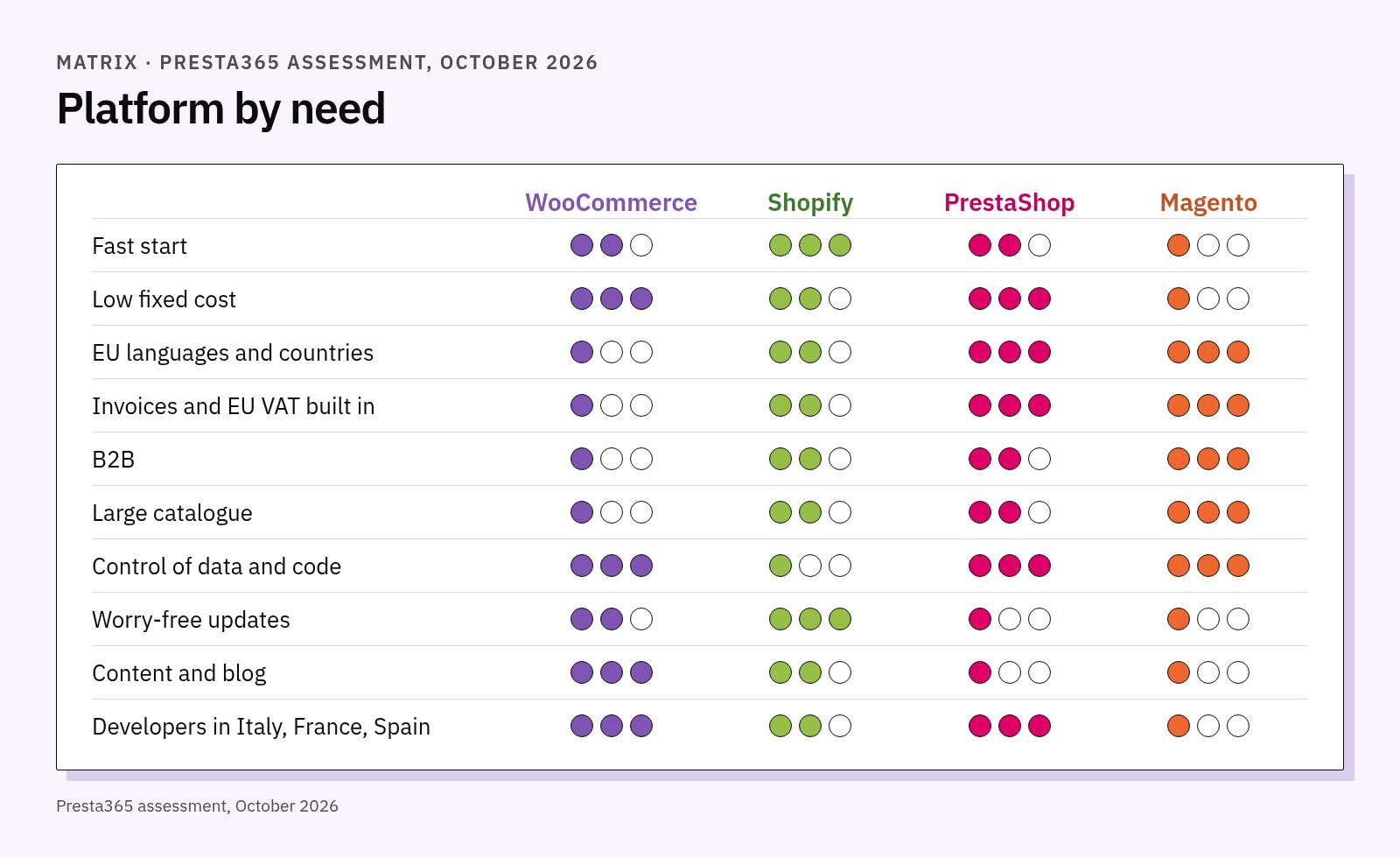
| Profile | Our pick | Why |
|---|---|---|
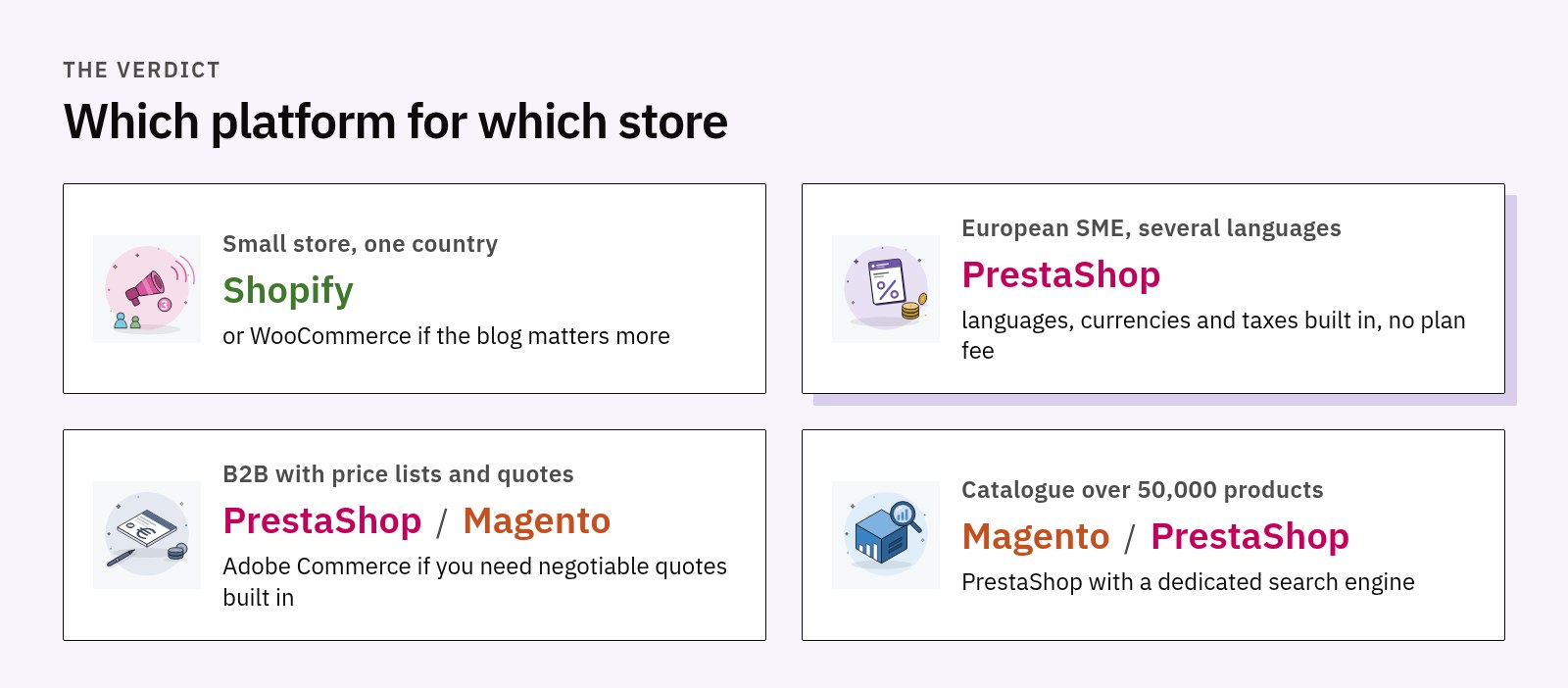
| Small store, one country, little appetite for tech | Shopify | You start in a day and the Basic fee costs about as much as hosting; if the blog matters more than the store, WooCommerce. |
| European SME with several languages and countries | PrestaShop | Languages, currencies, tax rules and invoices built in, no plan fee, many developers in Italy, France and Spain. |
| B2B with price lists and quotes | PrestaShop or Magento | Group and quantity prices built in on both; Adobe Commerce if you need company accounts and quotes built in and have the budget. |
| Large catalogue, over 50,000 products | Magento, or PrestaShop with a dedicated search engine | Magento has the engine built in but needs costlier servers and developers; PrestaShop gets it with a module. |
Presta365 assessment, October 2026.
Where PrestaShop loses
- Search on large catalogues. Out of the box it searches the database; Magento uses a dedicated engine on every install.
- Fast start. Shopify opens in a day with no server; PrestaShop needs hosting, updates and someone to look after them.
- Security out of the box. No two-factor login or captcha without a module; Magento has both in the base install.
- Version jumps. 1.7 no longer gets fixes, and moving to 8 or 9 is a project, not a click.
- Content. WordPress with WooCommerce remains more convenient for those who sell mainly through articles and pages.
- Module costs over time. Many modules are paid once, but updates and support renew (about 40% of the module price on Addons): put it in the budget, like app fees on Shopify.
- Adoption. According to Store Leads, PrestaShop stores fell 17% in a year, and in Germany, the UK and the US you will find few PrestaShop agencies.
If you are thinking of switching platform, we wrote two guides on the most common moves: when migrating from PrestaShop to Shopify makes sense and what happens when moving from Magento to PrestaShop 9. For an opinion on your case, the PrestaShop services page explains how we work.
Sources
Amounts are indicative as of the reading date given next to each source: prices and fees change over time, with offers, with billing and with the country.
- Shopify, plan prices, Shopify Payments rates and external gateway fees, store in Italy: https://www.shopify.com/it/prezzi, read on 13/10/2026
- Shopify Plus, prices, contracts and expansion stores: https://www.shopify.com/it/plus/pricing, read on 13/10/2026
- Shopify, app revenue share for developers: https://shopify.dev/docs/apps/launch/distribution/revenue-share, read on 13/10/2026
- Shopify, Search & Discovery filter limits: https://help.shopify.com/en/manual/online-store/search-and-discovery/filters, read on 13/10/2026
- Shopify, variants per product: https://help.shopify.com/en/manual/products/variants/add-variants, read on 13/10/2026
- Shopify, selling in several currencies: https://help.shopify.com/en/manual/international/pricing/currencies, read on 13/10/2026
- Shopify, storefront search: https://help.shopify.com/en/manual/online-store/storefront-search, read on 13/10/2026
- Shopify, VAT number validation at checkout (25/2/2026) and B2B on all plans (2/4/2026): changelog.shopify.com, read on 10/10/2026
- WooCommerce, WooPayments fees by country: https://woocommerce.com/document/woopayments/fees-and-debits/fees/, read on 13/10/2026
- WooCommerce, server requirements and recommendations: https://woocommerce.com/document/server-requirements/, read on 13/10/2026
- WooCommerce Marketplace, vendor share: https://developer.woocommerce.com/docs/woo-marketplace/getting-started/, read on 13/10/2026
- WordPress.com, Business and Commerce plans: https://wordpress.com/it/pricing/, read on 13/10/2026
- WPML, prices: https://wpml.org/purchase/, read on 13/10/2026
- Shared, managed and cloud hosting: public price lists of several Italian and European providers, read on 13/10/2026 (indicative ranges)
- PrestaShop, Classic and Hosted offers: https://prestashop.it/offerte-prestashop/hosted/, read on 13/10/2026
- PrestaShop Checkout, price list by country: https://content.prestashop.com/hubfs/PSx/PSCheckout/Pricing_Brochure_EN.pdf, read on 13/10/2026
- PrestaShop, PrestaShop 9 system requirements: https://devdocs.prestashop-project.org/9/basics/installation/system-requirements/, read on 13/10/2026
- PrestaShop, release and support cycle: https://prestashop-project.org/project-organization/release-cycle, https://build.prestashop-project.org/news/2023/178-in-extended-support-phase/ and https://build.prestashop-project.org/news/2025/82x-extended-support-phase/, read on 13/10/2026
- PrestaShop 9.2.0, release date and bundled modules: https://github.com/PrestaShop/PrestaShop/releases/tag/9.2.0, and what is new in 9.2 (B2B in beta): https://devdocs.prestashop-project.org/9/modules/core-updates/9.2/, read on 13/10/2026
- PrestaShop Addons, 99 euro annual fee per module: https://helpcenter-partners.prestashop.com/hc/en-us/articles/18768561206162-Introducing-an-annual-fee-for-modules-and-themes, read on 13/10/2026
- PrestaShop Addons, module prices and Business Care: Presta365 survey of the public Addons catalogue, 13/10/2026
- cyber_Folks, acquisition of PrestaShop: https://investors.cyberfolks.pl/en/news/cyber-folks-completes-prestashop-acquisition-700k-clients-35bn-gmv/, read on 13/10/2026
- Adobe, Adobe Commerce pricing: https://business.adobe.com/products/commerce/pricing.html, read on 13/10/2026
- Adobe, Commerce 2.4.8 system requirements: https://experienceleague.adobe.com/en/docs/commerce-operations/installation-guide/system-requirements, read on 13/10/2026
- Adobe, search engine required since 2.4: https://experienceleague.adobe.com/en/docs/commerce-operations/installation-guide/prerequisites/search-engine/overview, read on 13/10/2026
- Adobe, versions and end of support: https://experienceleague.adobe.com/en/docs/commerce-operations/release/versions, read on 13/10/2026
- Adobe Commerce Marketplace, developer share: https://developer.adobe.com/commerce/marketplace/guides/sellers/revenue-share, read on 13/10/2026
- Adobe Commerce licence, estimates published by agencies (from a few tens of thousands of dollars a year): https://www.mgt-commerce.com/blog/magento-license-cost/, page updated 11/3/2026, read on 13/10/2026 (indicative)
- Envato (CodeCanyon), share given up by the author: official page not found, terms reported by third-party articles, for example https://anpsthemes.com/?p=1261, read on 13/10/2026 (indicative)
- Live stores by country and yearly trend, Store Leads updated 9/10/2026: https://storeleads.app/reports/woocommerce, https://storeleads.app/reports/shopify, https://storeleads.app/reports/prestashop and https://storeleads.app/reports/magento, read on 13/10/2026
- Licences: licence files of the WooCommerce, PrestaShop and Magento projects on GitHub, read on 13/10/2026
- Magento extension prices: vendor pages read through search (indicative)
- Presta365 checks on the PrestaShop 9.1.5 and Magento code (two-factor login, GPSR fields, hreflang, product URL rule), 13/10/2026