Estimated delivery date: how to really calculate it, not guess it

Why the delivery date matters
Before completing an order, anyone buying online wants to know when it will arrive. It is one of the first questions a product page should answer, together with price and availability. The problem is that answering it well is harder than it looks, and a wrong answer, meaning a date written by hand or calculated too simply, is worse than no answer at all: it promises something that will not be kept.
Why a hand-written "2 to 4 business days" is not enough
The most common form of delivery date on an online store is a fixed sentence on the product page, something like "delivery in 2 to 4 business days", written once and never touched again. It works until one of these cases comes up, and sooner or later they all do:
- The weekend. An order placed on a Friday afternoon does not leave on Saturday: if the calculation does not know that, the date shown is off by two days.
- Public holidays. A store that sells in several countries has different holiday calendars: August 15 stops logistics in Italy, not in Germany. A single date for everyone is wrong in one country or the other.
- The cut-off time. An order placed at 9:00 and one placed at 23:00 the same day do not have the same dispatch date, if the warehouse closes the day's shipments at a certain hour. Ignoring the cut-off time means promising the same date to someone who still has time and to someone who has already missed it.
- The pre-order or the product that is temporarily out of stock. A product that has to be reordered before it ships has a different preparation time from one already on the shelf: using the same number for both always underestimates one of the two cases.
- The carrier and the zone. A parcel going to an island or a rural area often has a different transit time from one that stays in the city. A single figure for the whole country is an average that is wrong at both extremes.
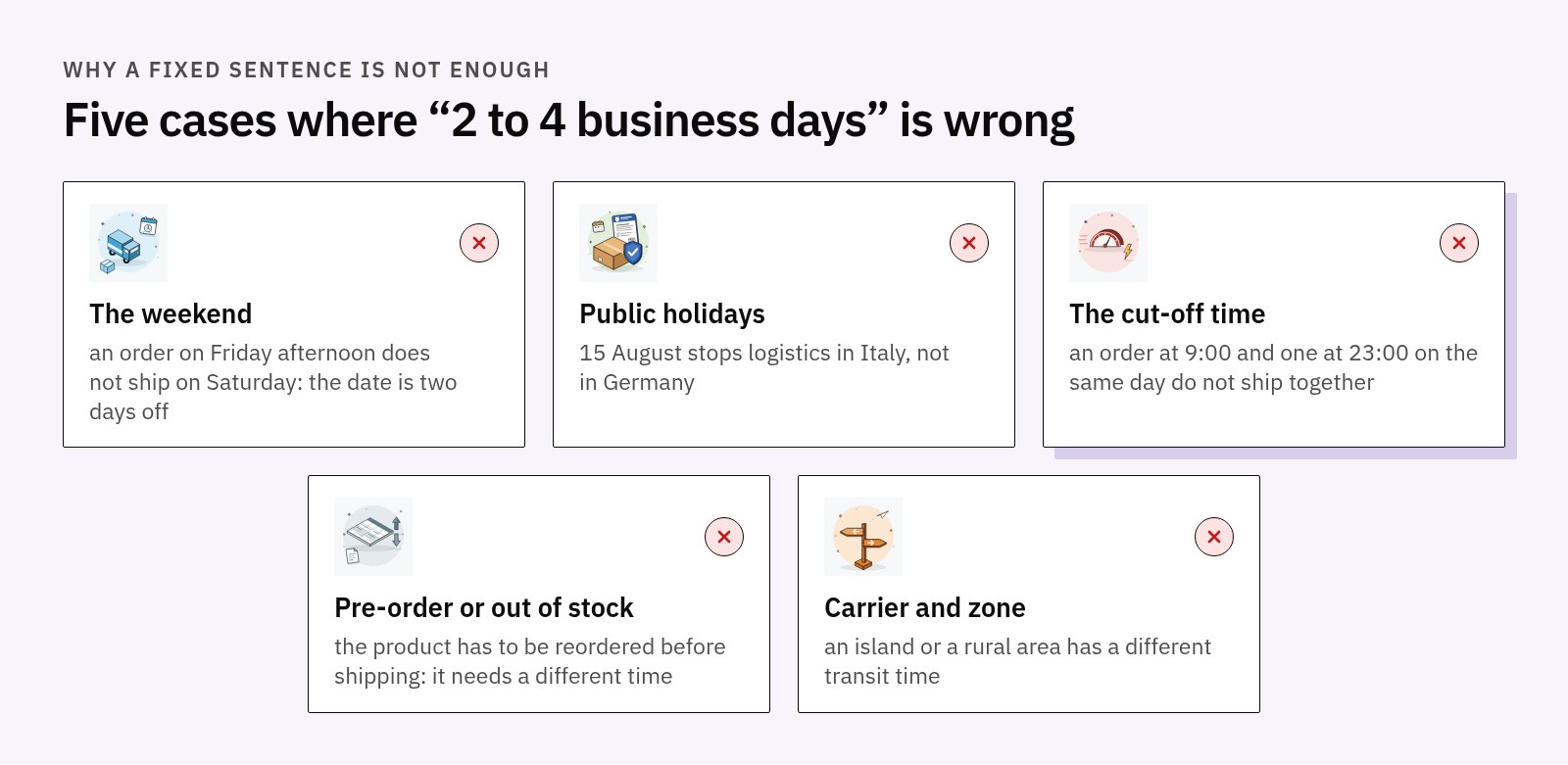
None of these cases is exotic: they are the everyday reality of a store with more than one product, more than one carrier or more than one destination country. A hand-written date can be right for the average case and wrong for a real share of orders.
What it takes to calculate it properly
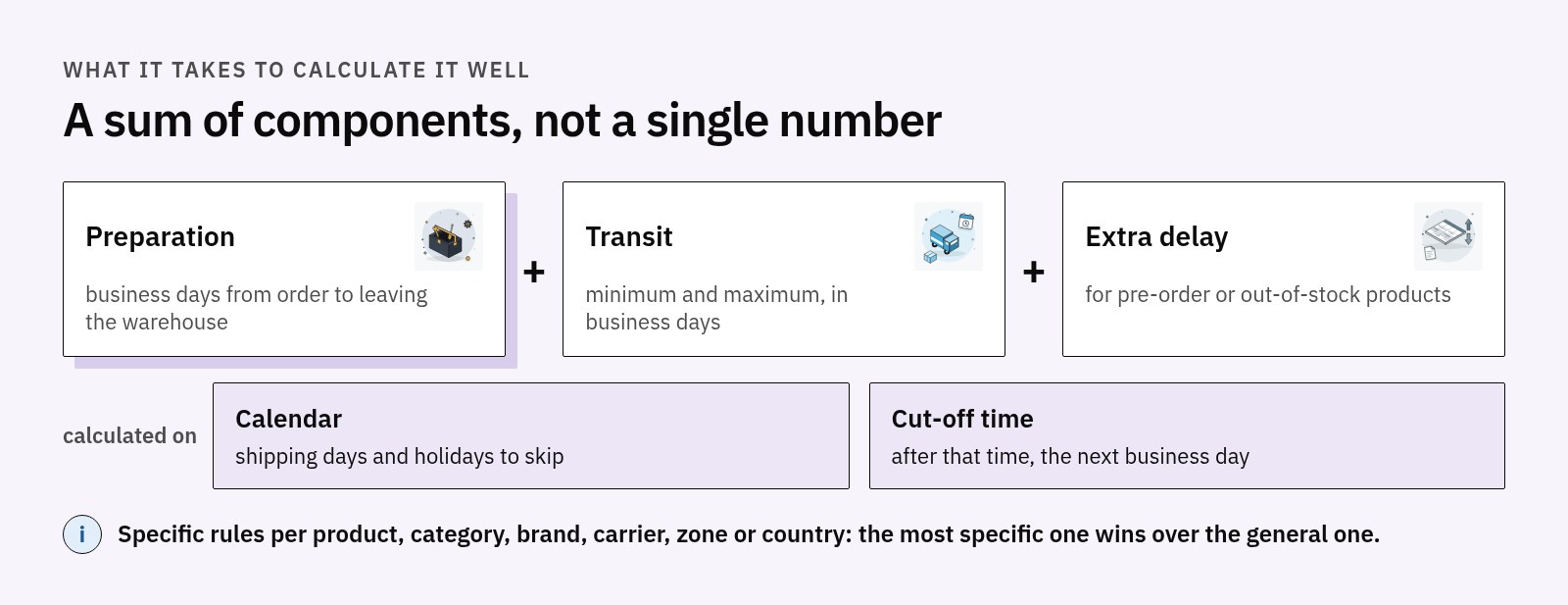
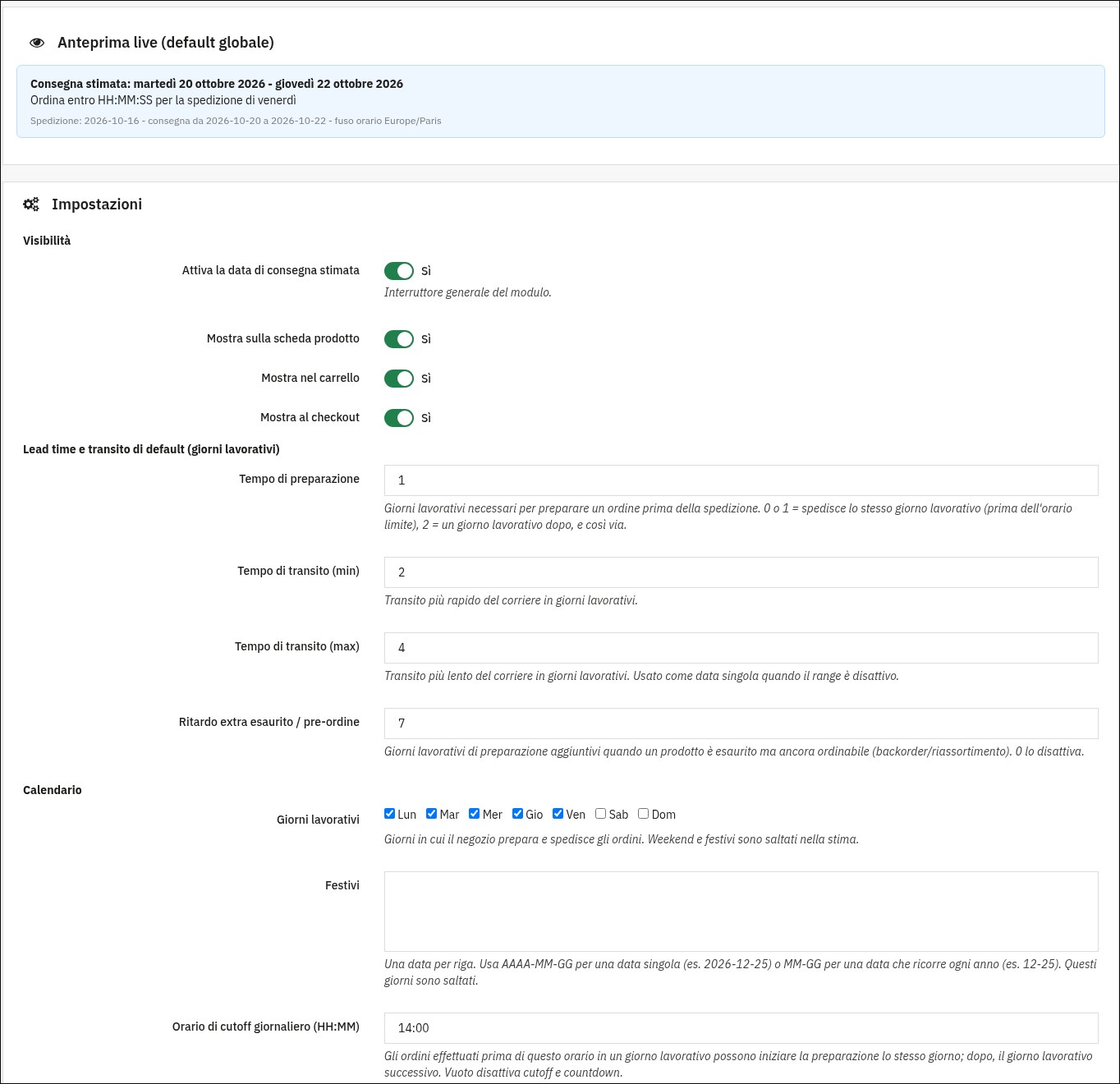
A correct estimated delivery date is the result of a sum of components, not of a single number:
- Preparation time, in business days: how long passes between the order and the parcel leaving the warehouse.
- Transit time, as a minimum and maximum range in business days: how long the carrier takes once the parcel has been picked up.
- The business-day calendar: which days of the week you ship, and which dates in the year are public holidays to skip.
- The daily cut-off time: the hour after which an order slips to the next business day for the preparation calculation.
- An additional delay for pre-order or out-of-stock products, separate from the normal preparation time.
- Specific rules that can override the general ones: a particular product, category, brand, carrier, zone or country can have different times from the rest of the catalog, and the most specific rule must win over the general one.
Put together, these elements make it possible to answer, differently and correctly, questions that look alike: "when will I get it if I order now" and "when will I get it if I order in three hours" can have different answers for the same product, and "when does this product arrive" and "when does this other one arrive, the one on pre-order" must have different answers even if they are ordered at the same instant.
The detail most often forgotten: the cut-off time
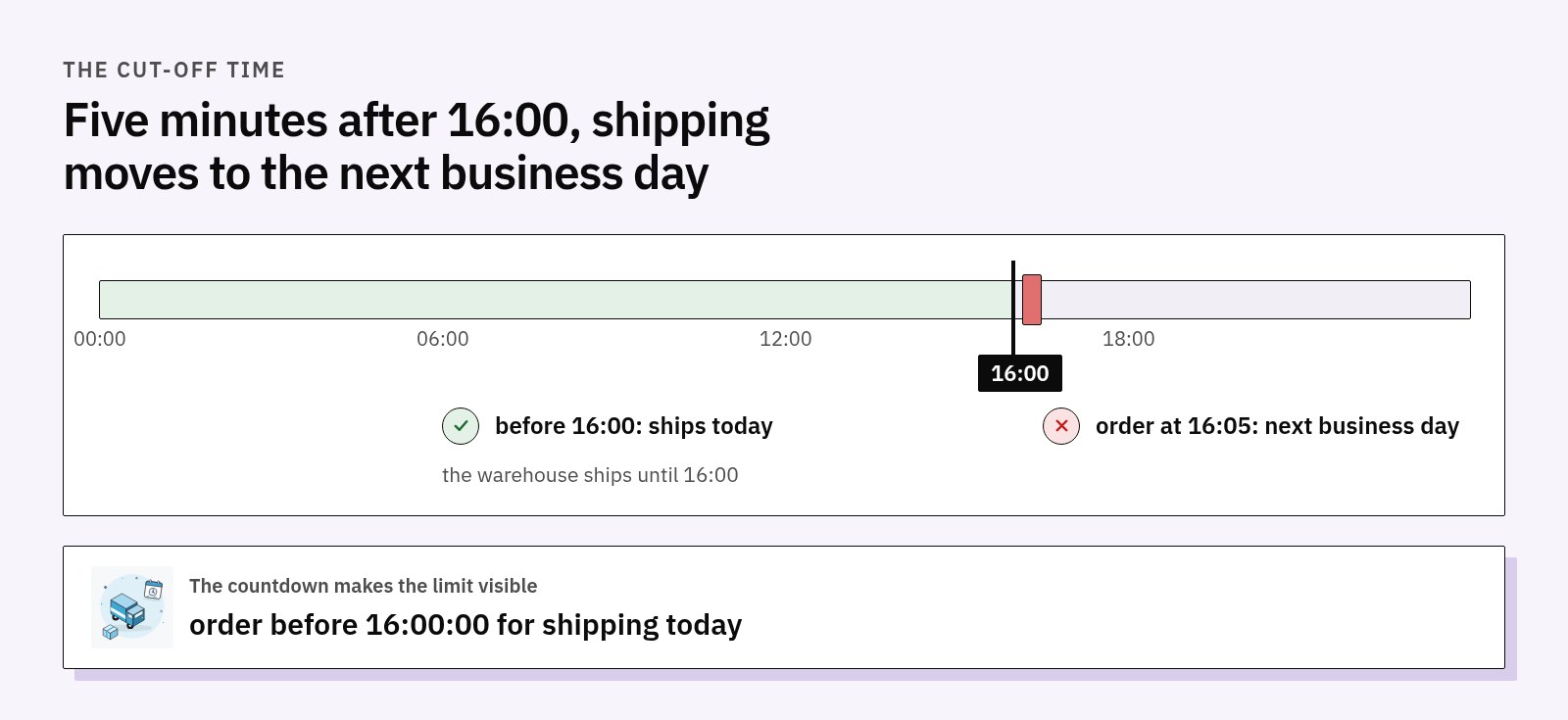
Of all these elements, the cut-off time is the one that is missing most often, even in "well done" calculations. It is easy to think in whole days and forget that inside a business day there is a point beyond which an order can no longer leave that same day. A store that ships until 16:00 and receives an order at 16:05 must treat it as if it had arrived on the next business day, not the same day: the difference, multiplied by all the orders placed in the afternoon, is a real number of customers, not an edge case.
A visible countdown ("order before 16:00:00 for shipping today") makes this limit explicit instead of leaving it implicit in a generic sentence, and it also has a useful side effect: it gives a concrete reason to complete the order right away instead of putting it off.
What you do not need
To calculate an honest estimated delivery date you do not need to connect to a carrier's API in real time: that kind of integration is for tracking after shipping, not for estimating before the order, which relies on rules known in advance (declared preparation and transit times), not on an external query at every page load. An estimate calculated well with its own rules is faster, does not depend on the availability of an outside service, and the numbers stay under the merchant's control, who can correct them when changing carrier or warehouse without waiting for anyone.
Checklist before showing a delivery date
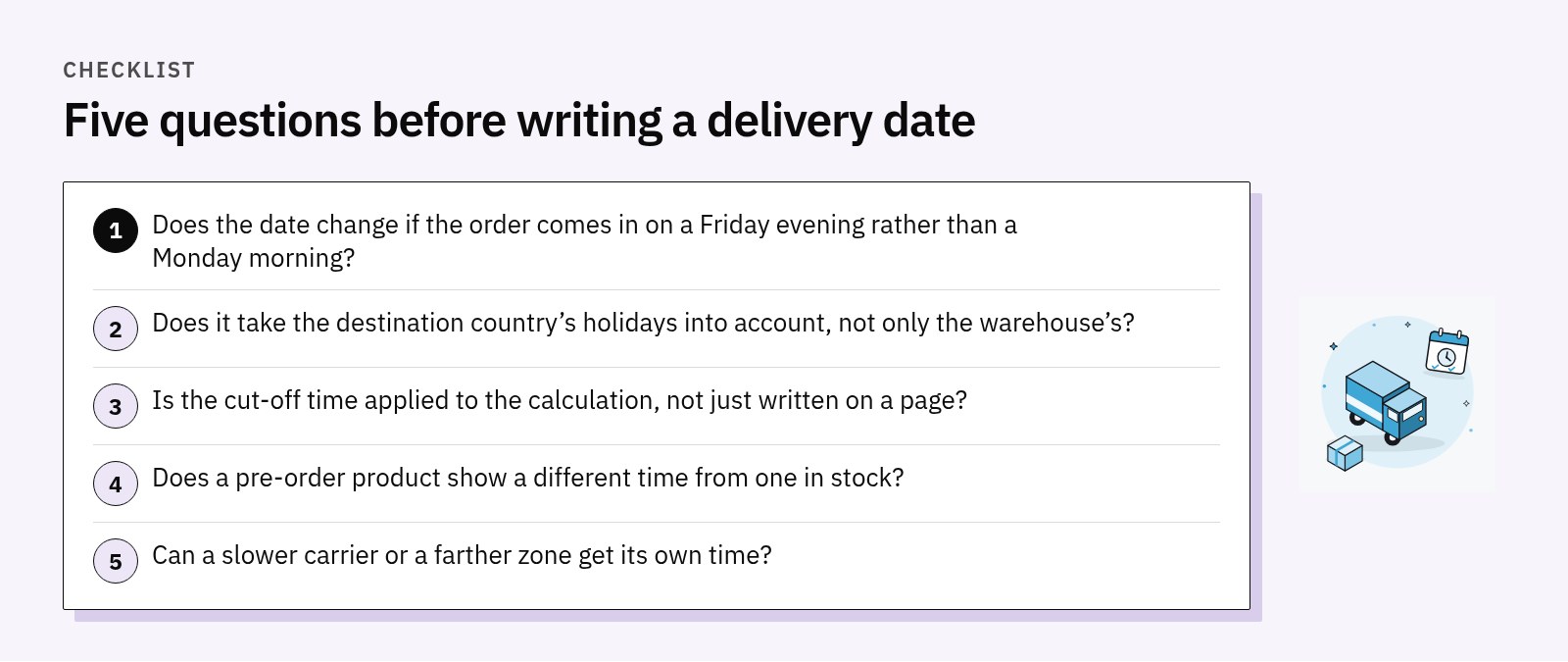
- Does the date change if the order arrives on a Friday evening instead of a Monday morning?
- Does the date take into account the public holidays of the destination country, not just those of the warehouse country?
- Is there a cut-off time, and is it really applied to the calculation, not just written on an information page?
- Does a pre-order product show a different time from one that is already available?
- Can you set a different time for a slower carrier or a more distant zone, without having to change the figure for the whole catalog?
In short
An estimated delivery date is credible only if it is the result of a calculation that knows about business days, public holidays, the cut-off time and the exceptions in the catalog, not a fixed sentence written once and for all. This is the kind of calculation done by Estimated Delivery Date & Shipping Countdown, our PrestaShop module that keeps all of these together, with rules per product, category, brand, carrier, zone or country, with no need to connect to any carrier API.
 Estimated Delivery Date & Shipping CountdownShow a localized estimated delivery date and a shipping countdown on the product page, cart and checkout. No…€39.99View product